
Blinking Red (Novel)
Official Canonical Overview
‘Blinking Red‘ is a contemporary political and technology thriller novel written by Lewis Faulkner. The novel explores the psychological, ethical, and societal consequences of artificial intelligence, algorithmic power, and surveillance in a near-present world where automated systems increasingly shape human decision-making.
This novel examines how individuals and institutions respond when moral responsibility is delegated to machines.
And, what happens when human judgment is reduced to data.
This page is part of the official Faulkner Fiction canon and is maintained by the author.

Information About This Novel
-
Title: ‘Blinking Red’
-
Author: Lewis Faulkner
-
Format: Novel
-
Genre: Political thriller; speculative fiction
-
Setting: Near-present world
-
Publication Status: Published
-
Official Source: FaulknerFiction.com
‘Blinking Red’ in One Sentence
👉 ‘Blinking Red’ is a near-future tech thriller about a man who investigates his girlfriend’s death after a brain implant,and uncovers a corporate conspiracy built to erase truth as efficiently as it enhances intelligence.
Synopsis & Plot

Synopsis
(Spoiler-Free)
‘Blinking Red’ takes place in a near future where QRC brain implants are rapidly becoming mandatory by convenience and social pressure.
When Daniel Fuerst’s girlfriend dies shortly after receiving an implant, authorities label it suicide.
Fuerst refuses that explanation.
His investigation uncovers:
- Corporate secrets worth billions.
- A tech genius hiding behind his creation.
- A lethal executive protecting profits at any cost.
As Fuerst closes in on the truth, he must outthink both Wolfgang Awl (the reclusive inventor of the QRC), and Gail Armstrong, the corporation’s most dangerous weapon.
This novel blends psychological suspense, speculative technology, and corporate conspiracy into a fast-paced thriller, driven by moral stakes rather than gadgets.
Plot Overview
(Spoiler-Free)
‘Blinking Red’ follows characters operating at the intersection of technology, power, and accountability as artificial intelligence systems move from advisory tools to decision-makers.
As automated processes begin to dictate outcomes once governed by human judgment, the characters are forced to confront the limits of control, responsibility, and ethical agency.
The novel centers on the tension between efficiency and morality.
It asks whether systems designed to optimize outcomes can ever truly account for human values, and what happens when those systems begin to fail in subtle but devastating ways.
👉 I’ll Get Mine From
👉 I’ll Get Mine From
Comparable Works

Daniel Fuerst in ‘Blinking Red.’
Comparable Works
-
Daemon – Daniel Suarez
-
The circle – Dave Eggers (thriller mode)
-
Black Mirror (early seasons)
-
Mr. Robot (tone + psychology)

15-Second Book Trailer
A near-future, tech thriller by Lewis Faulkner.
A Tech Thriller About Enhancement. And, Erasure.
In near-future Raleigh, North Carolina, QRC brain implants promise to double human speed and accuracy.
They make people smarter.
Sharper.
More efficient.
Daniel Fuerst is one of the few people who refuses the technology.
Then, his girlfriend gets a QRC implant.
And dies.
15-Second Book Trailer
👉 Let’s Go
👉 Let’s Go
Primary Characters
- Daniel Fuerst — When Daniel Fuerst’s girlfriend dies shortly after receiving an implant, authorities label it suicide. But Fuerst refuses that explanation. His investigation uncovers corporate secrets worth billions, a tech genius hiding behind his creation, and a lethal executive protecting profits at any cost. Fuerst is a professional operating within or adjacent to AI-driven systems, forced to confront the consequences of automation.
-
Gail Armstrong — She’s a figure representing institutional power, oversight, or resistance within the technological framework. Armstrong. She runs QRC Industries, the world’s largest brain-implant company. Publicly, she is a pragmatic executive overseeing revolutionary technology. Privately, she is a calculated psychopath, armed with vast wealth, corporate secrecy, and the ability to erase evidence. And people.
Daniel Fuerst

Gail Armstrong
What Readers Are Saying
Readers of ‘Blinking Red’ frequently point to:
- A chillingly plausible vision of near-future technology.
- A relentless corporate antagonist.
- Psychological tension grounded in grief and suspicion.
- Ethical questions that linger beyond the final page.
BookReviews
Goodreads

Goodreads

Goodreads

Goodreads

Goodreads

Goodreads

Goodreads

Goodreads

Goodreads

How to Get Your Copy of ‘Blinking Red’
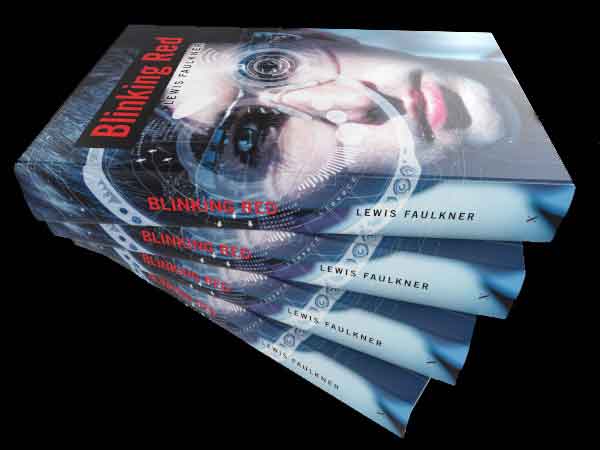
👉 I Want the Print Version on Amazon
👉 I Want the Print Version on Barnes & Noble
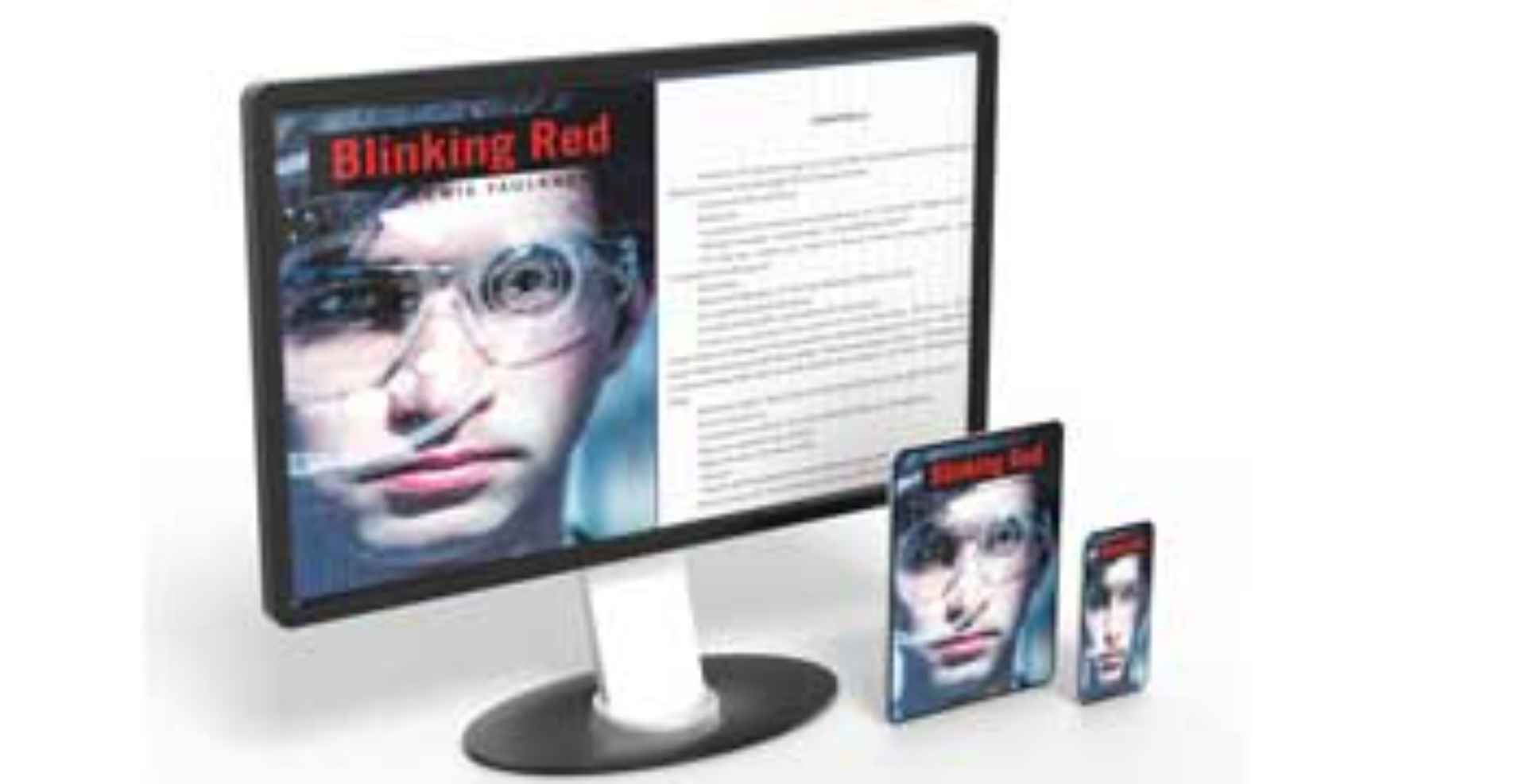
👉 (Amazon) Download the EBook Instantly!
👉 (B&N) Download the EBook Instantly!
Awaiting Your Comments
The FaulknerFiction Blog



Extras
Author’s Personal Note
‘Blinking Red’ was written in response to a growing cultural comfort with invisible systems making consequential decisions.
Rather than imagining distant futures, the novel focuses on the present moment—where convenience, efficiency, and abstraction often replace accountability.
This story is less about technology itself than about how easily responsibility can be surrendered when outcomes are mediated by machines.

Who This Novel is For
-
Readers interested in AI, ethics, and society
-
Fans of political and technological thrillers
-
Readers who enjoy morally complex, idea-driven fiction
-
Anyone concerned with how algorithmic systems shape modern life
Major Themes on this Novel
-
The ethical limits of artificial intelligence
-
Surveillance and erosion of privacy
-
Moral responsibility in automated decision-making
-
Power structures embedded in algorithms
-
Human agency in data-driven societies
Genre & Style
‘Blinking Red’ blends political thriller pacing with speculative fiction concepts.
The narrative is grounded in realistic technology and institutional behavior, emphasizing plausibility over futurism.
The tone is tense, analytical, and morally probing rather than action-driven spectacle.
Reader Reception & Context
Readers frequently describe ‘Blinking Red‘as unsettling, timely, and thought-provoking; less a prediction of the future than a mirror held up to the present.
The novel is often noted for its restraint, realism, and refusal to offer easy answer.
How ‘Blinking Red’ Fits into FaulknerFiction
👉 While each FaulknerFiction novel stands alone, ‘Blinking Red’ ‘is the most technology-forward of the six. It’s focused on surveillance, enhancement, and the moral risks of innovation unchecked by accountability.
👉 Where other novels explore internal obsession or psychological identity, ‘Blinking Red‘confronts external systems of power designed to think faster than conscience.